---
title: Machine & Shop Floor Data Acquisition | Heisenware
description: Connect every machine and digitize operator inputs to capture reliable production data. Build your MDA and SFDC solution with low-code, no months-long IT project.
---
[](https://heisenware.com?hsLang=en)
- [English](https://heisenware.com/solutions/machine-and-shop-floor-data-acquisition)
- [Deutsch](https://heisenware.com/de/loesungen/mde-bde)
- [Product](https://heisenware.com/product?hsLang=en)
- Solutions
- [Production Dashboards](https://heisenware.com/solutions/production-dashboards?hsLang=en)
- [Machine Data Acquisition](https://heisenware.com/solutions/machine-and-shop-floor-data-acquisition)
- [MPDV MIP Integration](https://heisenware.com/solutions/mpdv-mip-hydra-integration?hsLang=en)
- [RFID Tracking](https://heisenware.com/solutions/rfid-tracking?hsLang=en)
- [Pricing](https://heisenware.com/pricing?hsLang=en)
- Resources
- [Product Docs](https://docs.heisenware.com)
- [Case Studies](https://heisenware.com/case-studies?hsLang=en)
- [Blog](https://heisenware.com/blog?hsLang=en)
- [About us](https://heisenware.com/about?hsLang=en)
- [Schedule a Demo](https://heisenware.com/demo?hsLang=en)
- [English](https://heisenware.com/solutions/machine-and-shop-floor-data-acquisition)
- [Deutsch](https://heisenware.com/de/loesungen/mde-bde)
[Login](https://heisenware.cloud/manager/authentication/sign-in) [Talk to us](https://heisenware.com/contact?hsLang=en)
MACHINE & SHOP FLOOR DATA ACQUISITION
# See what every machine is really doing
Heisenware connects your machines and digitizes operator inputs, so you finally have reliable production data to act on. Build it with low-code, start on a single machine, and scale at your pace. No rigid off-the-shelf software, no months-long IT project.
[Start for free](https://heisenware.cloud/manager/authentication/sign-up) [Book a demo](https://heisenware.com/demo?hsLang=en)
### Manufacturers that trust Heisenware




PROBLEM
## Without reliable data, you're improving in the dark
Most machinery has grown over the years and never talked to your ERP or MES. When production data is captured by hand or not at all, it slows the floor down and quietly costs you margin.
### ❌ No foundation for OEE
Cycle times, utilization, and real downtime reasons stay invisible. Without reliable machine data, there's nothing solid to measure OEE against or improve in a targeted way.
### ❌ Manual entry burns time and trust
When operators log shift data, setup times, or scrap on paper or in Excel, it eats hours and feeds flawed numbers straight into your job costing.
### ❌ Every machine speaks its own language
Without native interfaces, pulling machine data together turns into a slow, costly IT project, and the silos just get pricier.
SOLUTION
## Fully automated data acquisition and mobile transparency
Heisenware gives your team ready-made components to connect machines, capture operator inputs, and visualize it all on the shop floor. No separate interface project for every piece of equipment.
### ✅ Native drivers, not expensive middleware
Connect modern equipment directly with built-in drivers for OPC UA, MQTT, Siemens S7, Heidenhain, SQL, or CSV. The connectivity is part of the platform.
### ✅ **Retrofit the older machines too**
Equipment without modern controllers comes online with affordable edge hardware like industrial PCs or a Raspberry Pi, capturing classic 24V signals safely and galvanically isolated, for example part counting via optocouplers.
### ✅ Standard hardware as operator terminals
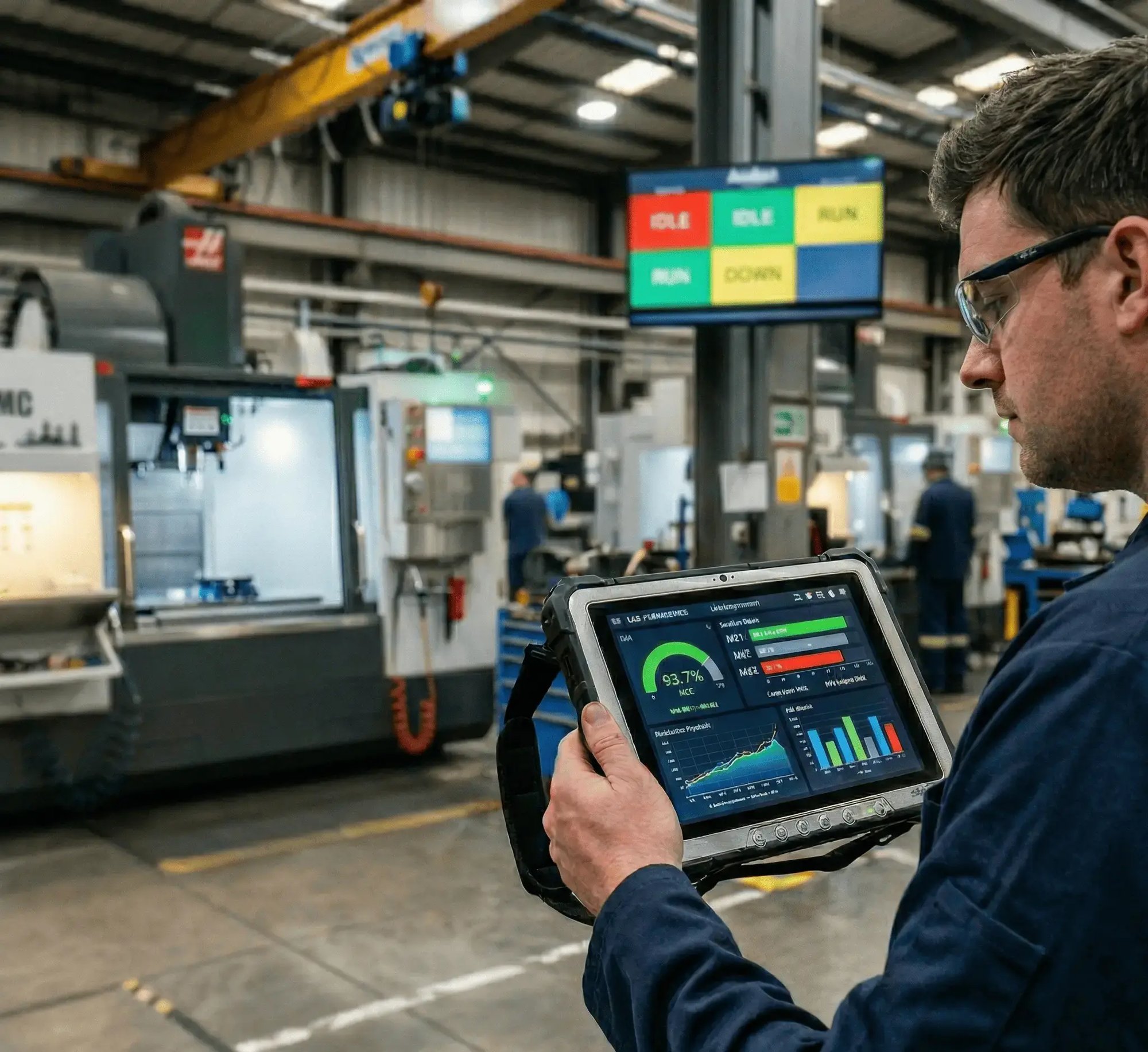
Downtime reasons, setup times, and scrap get entered digitally right at the machine. The interfaces run device-independently on standard tablets or monitors.
[Start for free](https://heisenware.cloud/manager/authentication/sign-up) [Book a demo](https://heisenware.com/demo?hsLang=en)
## **Case Study HEDELIUS**
### **Fully automated data acquisition and mobile transparency**
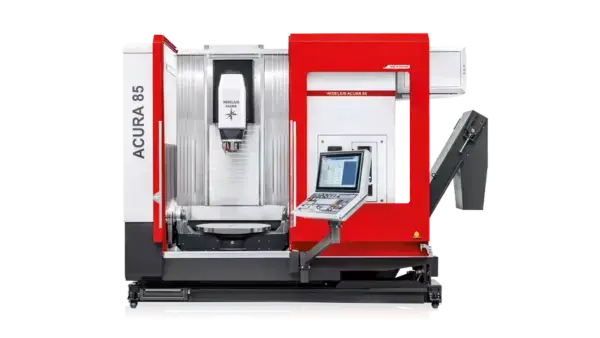
Machine builder HEDELIUS produces on its own state-of-the-art machining centers. They're so advanced that manual operator entries are obsolete: the machines deliver everything from runtimes and order data to specific downtime reasons straight from the controller.
The challenge was making that data usable. It needed to flow into the existing MES (MPDV HYDRA) for analysis, and production management wanted a fast overview of their equipment.
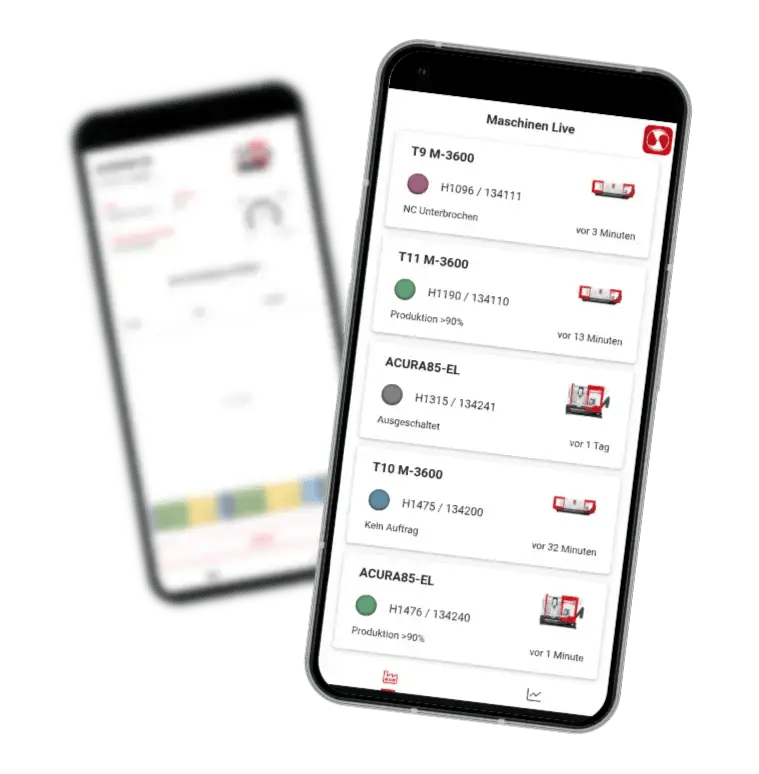
Instead of outsourcing a rigid interface project, the HEDELIUS team made Heisenware the central building block. The platform talks directly to the machine controllers via native drivers and forwards everything to the MES in real time. In parallel, the internal team built their own mobile app, where management now sees current machine status, active orders, target versus actual quantities, and historical trends on their phones, wherever they are.
## What's the difference between MDA and SFDC, and when does it make sense?
On the floor, machine data and shop floor data usually run as one system. But each does a different job on the way to transparent manufacturing.
### What is Machine Data Acquisition (MDA)?
MDA focuses on the equipment. It automatically collects objective raw data straight from the controller: runtimes, cycle times, temperatures, part counts. This is the hard foundation for calculating OEE and planning capacity.
### What is Shop Floor Data Collection (SFDC)?
SFDC adds the human context. Operators book their time to specific orders, document setup effort, and qualify the scrap and downtime reasons a machine can't detect on its own.
### When does it make sense?
The moment your team stops wanting to decide by guesswork and stale Excel lists. Combine MDA and SFDC well and you close the gap between the shop floor and the ERP, and the hidden inefficiencies surface on their own.
KEY FEATURES
## **The building blocks of your solution**
Modular components your team combines to capture and connect machine and shop floor data exactly the way your processes need it.
#### Connectivity
An edge-to-server architecture links the shop floor to your IT or the cloud, bi-directionally and over an encrypted channel.
#### PLC integration
Native drivers for OPC UA, Siemens S7, Heidenhain, and Modbus capture machine data automatically, with no detours.
#### IT integration
Connect ERP, MES, and databases bi-directionally via REST APIs, SQL, or automated CSV exchange.
#### Edge devices
Where modern interfaces are missing, microcomputers like the Raspberry Pi pick up digital signals right at the machine and pass them on.
#### Central database
All machine and production data flows with high performance into a data model shaped around your processes.
#### Operator terminals
Digital interfaces at the machine show orders, count parts, and prompt for downtime reasons the moment a stoppage happens.
#### Browser-based analysis
Analyze OEE, utilization, and shift data straight in the browser, with filters you can tailor yourself.
#### Andon monitors
Big screens on the floor show live machine status and historical data for full transparency.
#### Dashboard builder
Build the views you need for every kind of production data with drag-and-drop, no programming and no external service providers.
#### Mobile app
Live data and KPIs travel with you, so a quick overview is always one tap away.
[Start for free](https://heisenware.cloud/manager/authentication/sign-up) [Book a demo](https://heisenware.com/demo?hsLang=en)
HOW IT WORKS
## From first machine to full shop floor
Whether you want it delivered turnkey or your team drives it, the process stays agile and pragmatic. No months-long pre-projects, no rigid spec documents, just fast results on the floor.
### 1. Connect equipment and systems
First machines come online via native drivers like OPC UA or S7. Older machines are integrated in parallel with simple retrofit hardware, while the link to your existing ERP or MES is set up.
### 2. Adapt interfaces and logic
In the visual editor, you build the exact operator terminals and dashboards your production needs. You define the data model and decide precisely which machine data, downtime reasons, and times get recorded.
### 3. Test and scale
Data acquisition starts on a pilot machine under real conditions. Once it runs smoothly, you roll it out machine by machine, or across the whole floor, at your pace and without risk.
## FAQ
What teams usually want to know before they start.
### Who implements the solution?
Your call. Your technical teams can build it in self-service, Heisenware can deliver it turnkey, or an external system integrator can deploy it for you.
### Does it run in the cloud or on-premise?
Both. The platform follows your IT security rules, hosted by us in the cloud or installed entirely on your own servers.
### What hardware do we need?
No expensive special hardware required. Affordable industrial PCs or Raspberry Pi-based edge devices handle acquisition at the machine, and standard tablets or monitors are enough for the operator terminals.
### Can older machines without modern interfaces be connected?
Yes. Where OPC UA or Siemens S7 are missing, we pick up simple digital signals. In practice we transfer classic 24V signals via optocouplers, galvanically isolated, to the edge hardware, for example for part counting. It's completely feedback-free and needs no changes to the PLC.
[](https://heisenware.com/hs/cta/wi/redirect?encryptedPayload=AVxigLJYg6TM3dhFQKZ2OER1Ehz0vqnm7RZqgDU1GwU5s%2BUqqcExLKSP27aekwv5ygBEtkeUDW9u9RHpkLbclNSYZgjT0tQHi55Ld6p3lNfnEnPeyr%2BmczY9Z5nBbn4wNJb25qz%2BwIJXEe%2FJiozCWvjF%2BCem79ZiqPm%2Bjwu2uFV%2BoyY27HfS0k5OkTgVmeFzta7aqTgVoqmO5iskwNFVB%2FDuGxCG8upAeojdEVIbZhBEUw%3D%3D&webInteractiveContentId=386096579795&portalId=26577580&hsLang=en)
[](https://heisenware.com?hsLang=en)
**The platform for technical teams to build production-grade industrial software visually.**
[mailto:hello@heisenware.com](mailto:hello@heisenware.com)
### Company
- [About](https://heisenware.com/about?hsLang=en)
- [Contact us](https://heisenware.com/contact?hsLang=en)
- [Blog](https://heisenware.com/blog?hsLang=en)
- [Jobs](https://join.com/companies/heisenware)
- [Press](https://docs.google.com/document/d/1nwrKTdNvyZDZZoZSJjMUkZpOIcMqSojxjBkXH9gP3bY/edit?tab=t.0#heading=h.qwzdizd1m35h)
- [Podcast](https://heisenware.com/podcast?hsLang=en)
### Product
- [Overview](https://heisenware.com/product?hsLang=en)
- [Login](https://heisenware.cloud)
- [Docs](https://docs.heisenware.com/)
- [Pricing](https://heisenware.com/pricing?hsLang=en)
- [Book a Demo](https://heisenware.com/demo?hsLang=en)
### Compare
- [vs. Mendix](https://heisenware.com/compare/mendix?hsLang=en)
- [vs. Node-RED](https://heisenware.com/compare/node-red?hsLang=en)
- [vs. Peakboard](https://heisenware.com/compare/peakboard?hsLang=en)
### Solutions
- [Machine Data Acquisition](https://heisenware.com/solutions/machine-and-shop-floor-data-acquisition)
- [Production Dashboards](https://heisenware.com/solutions/production-dashboards?hsLang=en)
- [MPDV MIP Integration](https://heisenware.com/solutions/mpdv-mip-hydra-integration?hsLang=en)
- [RFID Tracking](https://heisenware.com/solutions/rfid-tracking?hsLang=en)
### Industries
- [Machine OEMs](https://heisenware.com/solutions/machine-builders?hsLang=en)
- [Manufacturers](https://heisenware.com/solutions/manufacturing?hsLang=en)
- [Manual Assembly](https://heisenware.com/solutions/manual-assembly?hsLang=en)
- [System Integrators](https://heisenware.com/solutions/system-integrators?hsLang=en)
### Case Studies
- [Delta Energy Systems](https://heisenware.com/case-studies/delta?hsLang=en)
- [Elnic in Dresden](https://heisenware.com/case-studies/elnic?hsLang=en)
- [Gaerte](https://heisenware.com/case-studies/gaerte?hsLang=en)
© 2026 Heisenware GmbH | All rights reserved [Terms of Service](https://heisenware.com/en/legal/terms?hsLang=en) [Privacy Policy](https://heisenware.com/en/legal/privacy-policy?hsLang=en) [Imprint](https://heisenware.com/en/imprint?hsLang=en)
[Powered by Atlas - a B2B SaaS HubSpot theme](https://www.kalungi.com/atlas-hubspot-theme-for-b2b-saas-software)